
Does UV-cap co-extrusion PVC WPC die with optimized foaming ratio make weather-resistant, moisture-proof door panels?
08-07-2026
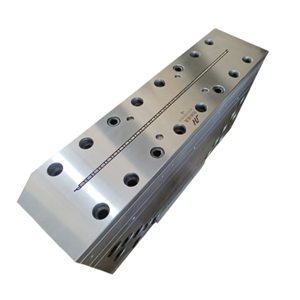
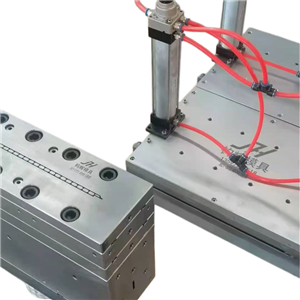
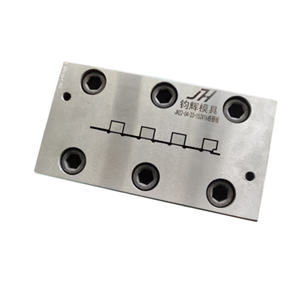
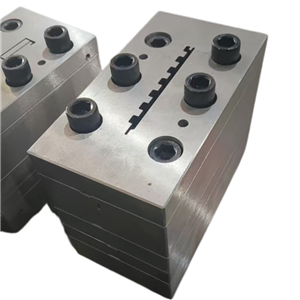
In the production of PVC and wood-plastic composite (WPC) door panels, door jambs, and architraves, the extrusion die is the decisive factor in whether the finished product meets architectural specs for colour-retention (UV stability), dimensional flatness, surface density, and moisture resistance. Generic profile dies often lack a dedicated cap-layer manifold — forcing you to run solid-colour throughout or accept poor cap-layer thickness control — and their compression zones are not tuned for WPC micro-cellular foaming, leading to coarse cells, surface orange-peel, or density variation across wide door-planar sections. The PVC WPC Anti UV Moisture Soundproof Thermal Door Extrusion Die Mold — Alloy Steel CNC Machined Flow Channel for UV Cap Coextrusion Micro Cellular Foaming WPC Door Panel Profile Custom Cross Section Heat Treated (from Hubei Junhui Mold Co., Ltd., JUN HUI® Brand) solves both issues. Its upper manifold incorporates a separate, calibrated cap-layer distributor so a UV-stabilised colour-compound can be co-extruded as a thin (0.3–0.8 mm) outer skin — protecting the core from photo-degradation while allowing cost-effective filler-rich substrate. Downstream, the pre-land and land sections are profiled with a foaming-optimised compression ratio (typically 2.5:1–4:1 depending on WPC formulation) to promote uniform cell nucleation and prevent collapse before the profile enters the vacuum calibrator. But how does the co-extrusion manifold maintain cap-layer thickness uniformity on a 800 mm wide door plank, what compression ratio suits Celuka vs. free-foam WPC door cores, and which die-maintenance habits preserve surface gloss over long runs? Here is the full breakdown for WPC door mills, PVC profile OEMs, and tooling-engineering buyers.
Why Dedicated UV-Cap Co-Extrusion Manifold Matters for Door-Skin Longevity
A PVC WPC Anti UV Moisture Soundproof Thermal Door Extrusion Die Mold — Alloy Steel CNC Machined Flow Channel for UV Cap Coextrusion Micro Cellular Foaming WPC Door Panel Profile Custom Cross Section Heat Treated (from Hubei Junhui Mold Co., Ltd., JUN HUI® Brand) separates the melt stream:
- Cap-Layer Distributor (Upper Manifold): A restricted-flow, fish-tail or coat-hanger style manifold meters the UV-stabilised compound (typically TiO₂-loaded rigid PVC or ASA-capped PVC) to a uniform 0.3–0.8 mm thickness across the full width — verified by ultrasonic or micrometer check on start-up samples. This thin skin blocks UV-A/B penetration to the wood-fibre core, preventing greying and chalking on exterior-facing doors.
- Core-Layer Distribution (Main Manifold): The bulk WPC or foamed-PVC melt (often high filler-load, CaCO₃ 30–50 phr) is distributed through a larger-volume channel with choked/restricted zones to equalise pressure across wide sections — critical for 600–900 mm door blanks where edge-to-centre pressure variance can cause bow or cell-size gradient.
- Merge Zone Before Land: Cap and core merge just upstream of the die land — the interface is designed to avoid flow lines ("snakeskin" defects) while preserving cap integrity; land length is pre-compensated for PVC die-swell (1.15–1.30×) and foaming expansion.
Key Specification Points (From Junhui PVC WPC Door Die Page)
- Product Designation: PVC WPC Anti UV Moisture Soundproof Thermal Door Extrusion Die Mold
- Die Body Material: Premium alloy steel — 40Cr die steel (forged, quenched & tempered to HRC 28–32 typical); mandrel / core rods optional stainless (3Cr13 / 4Cr13) for corrosion resistance in WPC high-moisture lines
- Heat Treatment: Rough-machine → stress-relief anneal → finish-grind / polish — preserves dimensional stability under sustained 170–190°C barrel pressure & thermal cycling
- Machining Accuracy: ± 0.01–0.02 mm on profile-defining surfaces (die lip, mandrel OD/ID for hollow jamb); flow-channel surface Ra ≤ 0.4 µm (mirror-polish or hard-chrome-plate on request)
- Co-Extrusion Feature: Single or dual cap-layer manifold — supports UV-resistant cap, coloured ASA/PVC cap, or rigid-foam cap over foamed core
- Foaming Compression Ratio (Land Pre-Land): Tuned 2.5:1–4:1 (Celuka / semi-Celuka WPC door panels); free-foam variants use lower compression — Junhui adjusts per customer's WPC formulation (blowing-agent type & loading, cell-regulator)
- Calibration / Cooling Sleeve (Optional Match): Vacuum calibration block-set (multi-piece aluminium or stainless) contoured to die exit — ensures first 300–600 mm sets flatness and corner-radius fidelity; water-manifold cooling sleeves for hollow jamb extrusions
- Custom Inputs Required:
- Full CAD cross-section (DWG / DXF / STEP) of door panel or jamb — include wall-thickness, hollow chambers, embossed texture zones
- Extruder die-head mount flange (e.g., Ø 65 mm / Ø 80 mm conical twin-screw, clamp-ring or bolt pattern)
- PVC vs. WPC formulation notes (foaming yes/no, filler %, cap-layer material & thickness target)
- Desired co-extrusion layers (1-cap / 2-cap / none)
- Lead Time (Typical): 25–40 days after drawing approval (complex wide-door die may trend longer)
- After-Sales: Die-trial support (remote or on-site in China), spare mandrels / die-lips / restrictor bars available separately
Typical Door-Profile Applications & Die Configurations
- PVC / WPC Hollow or Solid Door Panels (Flat / Embossed): 600–1000 mm wide × 35–45 mm thick — die includes emboss-plate pocket (optional) and cap-coextrusion manifold; calibration block-set matches.
- Door Jambs / Architraves (Hollow Rectangular or L-Shaped): Mandrel-supported hollow die; wall-thickness tolerance ± 0.15 mm; often run as twin-strand side-by-side.
- Casement / Side-Lite Frames (Multi-Chamber): Complex internal ribbing — die land and pre-land choke-points tuned per chamber width to equalise fill; co-extrusion cap on exposed face only if specified.
- WPC Ceiling / Wall-Cladding Panels (Related): Same die-platform family — Junhui can adapt width/emboss for matching interior cladding runs.
Die Care & Surface-Preservation Tips for Long Runs
- Pre-Heat Die to Process Temp Before Screw Start: 170–190°C for rigid PVC/WPC — avoids thermal shock to plated flow faces.
- Use Compatible Purge Compound on Colour/Formula Change: Prevent cross-contamination; do NOT leave degraded WPC bake in die overnight (cellulose fibre chars → carbon build-up in corners).
- Disassemble for Cleaning Only When Manageably Cool: Use proper die-puller; avoid hammering mandrel — thermal gradient can seize it.
- Periodic Re-Chrome / Re-Polish: On high-volume runs (> 500–800 t through one die) mirror-finish degrades — return for re-work before surface streak complaints arise.
- Store Dies Horizontal on Wooden Pallets in Climate-Controlled Room: Large door-die bodies can warp if leaned vertically long-term; label with profile-ID & last-run date.
Sourcing Checklist for WPC Door Mills & Profile OEMs
When requesting a quote for the PVC WPC Anti UV Moisture Soundproof Thermal Door Extrusion Die Mold — Alloy Steel CNC Machined Flow Channel for UV Cap Coextrusion Micro Cellular Foaming WPC Door Panel Profile Custom Cross Section Heat Treated (from Hubei Junhui Mold Co., Ltd., JUN HUI® Brand):
- ✅ Provide complete door-panel / jamb cross-section CAD (include embossed texture zones, hollow chambers, wall-thickness callouts).
- ✅ Specify extruder make/model & die-head mount flange (photo/drawing helpful).
- ✅ State material system — rigid PVC / WPC (foamed Celuka / free-foam / solid) / co-extrusion cap-layer type & target thickness.
- ✅ Confirm single vs. twin-strand / co-extrusion needs (UV-cap, ASA-cap, foam-core etc.).
- ✅ Ask about matching vacuum calibration blocks / water-cooling sleeves / haul-off guide jigs if new line setup.
Conclusion: Mould the Performance Before the Profile Leaves the Die
The PVC WPC Anti UV Moisture Soundproof Thermal Door Extrusion Die Mold — Alloy Steel CNC Machined Flow Channel for UV Cap Coextrusion Micro Cellular Foaming WPC Door Panel Profile Custom Cross Section Heat Treated (from Hubei Junhui Mold Co., Ltd., JUN HUI® Brand) is purpose-built for the demanding geometry and multi-material requirements of modern PVC/WPC door systems. Its co-extrusion manifold safeguards long-term colour stability via a controlled UV-cap layer; its foaming-optimised compression and land design promote uniform micro-cellular structure in WPC cores — yielding flat, dense, moisture-resistant door panels and jambs. For WPC door manufacturers, PVC profile OEMs, and architectural-millwork extruders wanting a die that accounts for real-world formulation variables rather than a generic profile shape, Junhui's PVC WPC door-series extrusion die is the correct specification.